



Cities across the United States are under growing pressure to respond to public safety concerns faster than ever. Crime evolves, resources are stretched, and public expectations keep rising. People want visible action, not long timelines.
So what actually works?
Solutions like the mobile surveillance trailer are gaining traction across U.S. cities. Early use cases point to clear advantages: faster response, wider coverage, and reduced strain on personnel.
But adoption isn’t straightforward. Questions around cost, privacy, and long-term effectiveness remain.
So, where does a mobile surveillance trailer fit: short-term fix or long-term strategy?
The Challenge: Rising Pressure on Public Safety
Public safety concerns in the United States are shaped by a complex mix of real-world trends and public perception.
On a national level, violent crime has generally declined over the past few decades and continues to trend downward in recent years. However, that broader trend doesn’t tell the full story. Crime remains highly concentrated in specific locations, and incidents can shift quickly between neighborhoods and public spaces.
At the same time, crime still occurs at a scale that demands constant attention. According to FBI data, a violent crime happens approximately every 25.9 seconds in the United States. There is an ongoing need for visibility and rapid response.
More importantly for cities, recent data shows that localized spikes continue to occur in major urban areas, even as national numbers improve. These fluctuations are often most visible in public-facing environments such as parks, transit systems, and downtown corridors.
This creates a growing challenge for municipalities: crime is not evenly distributed, and it doesn’t stay in one place. Instead, it concentrates across temporary and shifting hotspots.
In these areas, safety concerns directly impact daily life and require faster and more adaptable responses. At the same time, budget constraints limit hiring and infrastructure expansion.
Municipalities are under pressure for immediate reactions, which poses a change to the process of designing public safety strategies.
Why Traditional Approaches Aren’t Always Enough
Traditional public safety strategies remain essential. But, they are increasingly difficult to scale effectively in today’s environment.
Police patrols, for example, are inherently reactive and require significant staffing to maintain consistent coverage. As departments face ongoing personnel shortages, maintaining a visible presence across multiple high-risk areas becomes harder to sustain.
Fixed CCTV systems offer strong investigative value, but they come with limitations. Installation often requires permits, trenching, wiring, and long procurement cycles. This delays deployment by months. More importantly, once installed, these systems remain fixed, unlike crime patterns.
This creates a mismatch: cities invest in permanent infrastructure, while crime remains dynamic.
Over time, the cost of overtime patrols and maintaining static systems can exceed the cost of more flexible alternatives.
What Can a Mobile Surveillance Trailer Do That Traditional Security Can’t?
This is where the mobile surveillance trailer enters the picture: not as a replacement for existing systems, but as a flexible layer that fills critical gaps.
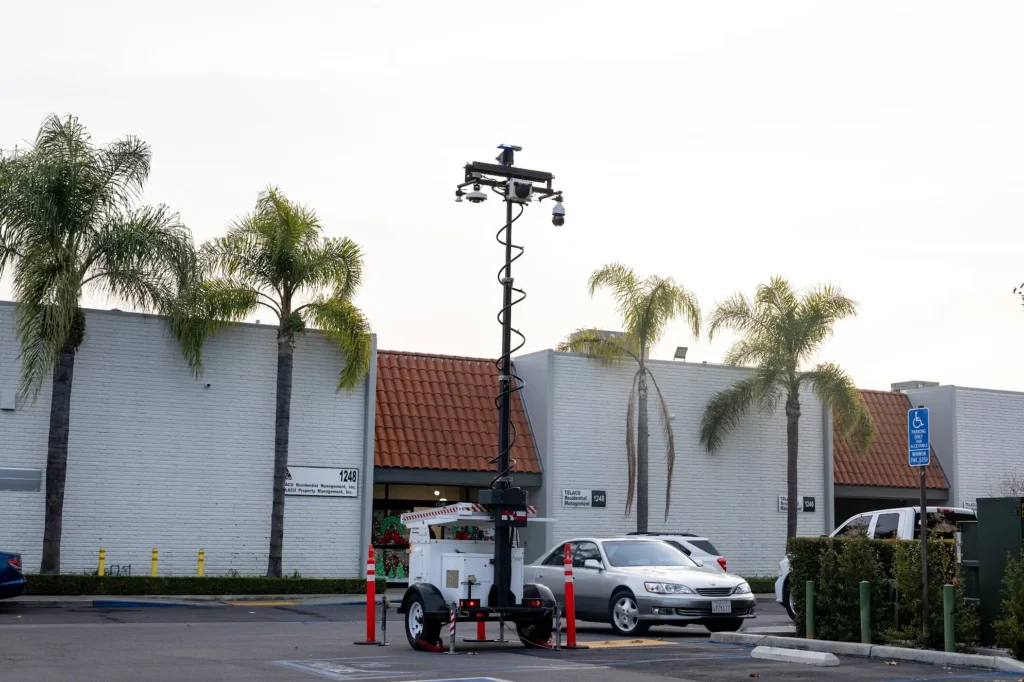
Unlike fixed infrastructure, a mobile surveillance trailer can be deployed within hours and relocated as needed. This makes it particularly effective for emerging or temporary hotspots, such as large events or seasonal spikes in activity.
A single unit combines:
- Elevated camera towers for high-visibility monitoring
- 360° coverage to reduce blind spots
- Solar-powered, off-grid operation
- Remote access with real-time alerts
For a closer look at how these systems operate in practice, this breakdown of surveillance trailer features and operation explains how each component contributes to overall performance.
Research also supports the effectiveness of surveillance when deployed strategically. A meta-analysis covering more than 40 years of studies and over 80 evaluations found that CCTV systems can produce measurable reductions in crime. It focuses on targeted environments like parking lots and residential areas. The study also highlights that actively monitored systems and those combined with other safety measures tend to deliver stronger results.
This aligns closely with how mobile surveillance trailers are used today: targeted, monitored, and integrated into broader public safety strategies.
As technology evolves, artificial intelligence is further enhancing these systems. Tools such as automated detection and real-time analytics are improving response times and situational awareness.
Table: Traditional Surveillance vs. Mobile Surveillance
| Factor | Traditional Surveillance (Fixed CCTV & Patrols) |
Mobile Surveillance Trailer |
| Deployment Time | Weeks to months (permits, wiring, installation) | Hours to a day |
| Flexibility | Fixed location, difficult to relocate | Repositioned as crime patterns shift |
| Coverage | Limited to installed areas | Wide, elevated coverage with fewer blind spots |
| Cost Structure | High upfront infrastructure costs | Lower upfront cost, rental options available |
| Scalability | Slow and capital-intensive | Easily scalable based on need |
| Staffing Requirements | High (patrols, monitoring, maintenance) | Reduced on-site staffing with remote monitoring |
| Effectiveness in Hotspots | Slower response to emerging issues | Ideal for temporary and emerging hotspots |
| Infrastructure Dependency | Requires power, wiring, trenching | Often solar-powered, off-grid capable |
| Adaptability | Low; static once installed | High; moved and redeployed quickly |
| Use Case Suitability | Long-term, permanent coverage | Events, parks, construction zones, temporary risks |
| ROI Timeline | Longer (delayed implementation) | Faster impact due to immediate deployment |
Strategic Uses of a Mobile Surveillance Trailer
The flexibility of a mobile surveillance trailer allows cities to deploy it where it delivers the most impact. The need for them often occurs in areas where traditional infrastructure falls short.
Common use cases include:
- Parks experiencing after-hours incidents
- Downtown retail corridors with fluctuating foot traffic
- Transit stops and stations
- Construction zones tied to public projects
- Large public events and gatherings
- Vacant municipal properties
- Parking lots and civic centers
These environments share a common challenge: they are highly visible, difficult to monitor consistently, and prone to shifting risk patterns.
Rather than committing to permanent installations too early, cities can use mobile systems to stabilize these areas, gather data, and determine whether long-term infrastructure is justified.
Budget Remains the Biggest Concern
Now that we have largely shown the benefits of deploying mobile security trailers, let’s look at the constraints for municipalities.
Budget remains one of the biggest barriers to adopting new public safety tools. However, here we have a different financial model compared to traditional infrastructure.
Fixed CCTV systems often require significant upfront investment, including construction, wiring, and long-term maintenance. In contrast, mobile units eliminate many of these costs:
- No trenching or permanent installation
- Reduced reliance on overtime patrols
- Faster deployment with immediate impact
- Flexible deployment based on need
Cities also have the option of mobile surveillance trailer rental, which allows them to address short-term needs.
Instead of committing large budgets to fixed systems in uncertain locations, cities can test, adjust, and scale their approach based on real-world results.
Successful Use Cases: From Theory to Practice
Across the United States, law enforcement agencies are increasingly incorporating mobile surveillance into their public safety strategies.
- Midland, Texas – Real-world deployments reflect these advantages. In Midland, Texas, the city implemented mobile surveillance trailers in public parks to improve safety while reducing reliance on on-site personnel. The systems enabled broader coverage with fewer staffing demands, helping the city respond more efficiently without significantly increasing operational costs.
- In Jacksonville, the Sheriff’s Office Department has used mobile units to monitor high-risk areas and support investigations. Where permanent infrastructure is not feasible, camera trailers provide visible deterrence.
- In 2024, San Francisco launched a citywide initiative to deploy mobile surveillance units in an attempt to move toward more flexible and rapidly deployable security solutions.
The key advantage is not just coverage, but timing. Mobile systems allow cities to intervene early, stabilize problem areas, and gather actionable data before deciding on long-term solutions.
The Bigger Picture: The Layers of Modern Public Safety
The most effective public safety strategies are layered. They combine multiple methods, merging security personnel, surveillance technology, and data-driven decision-making. A mobile surveillance trailer is not a replacement for law enforcement or traditional infrastructure, it is a force multiplier.
- It enhances patrol efficiency
- It helps crime investigations by providing documented, high-quality evidence
- It increases visibility and deterrence
- It supports faster, more coordinated responses
Mobile surveillance fits into this model by adding flexibility. It allows cities to respond quickly and adapt to changing conditions. Their successful deployment across multiple US public spaces attests to their practicality and ROI.
Contact us if you’re exploring how a mobile surveillance trailer could support your operations. Reach out for a free quote and rental options tailored to your specific requirements.