





Creating a security budget isn’t just about setting money aside for guards or cameras. It’s about allocating resources strategically so every dollar works harder. In cities like Los Angeles, where permitting costs, neighborhood crime patterns, and compliance requirements can all affect spending, planning becomes even more critical. Spend too little and you leave gaps, spend too much and you tie up capital unnecessarily.
This article outlines the key steps to creating a security budget that protects your employees and assets without overspending.
Laying the Groundwork: A Few Initial Steps
There are several factors to consider before you actually start planning your security budget.
1. Conduct a Risk Assessment
Every good plan starts with developing situational awareness and assessing risks. Some may cause only minor disruptions, while others can lead to significant financial loss or reputational damage.
Key factors that influence risks include:
- Business size – larger facilities require more coverage
- Location – high-crime neighborhoods may demand more patrols or surveillance
- Industry type – construction sites, for example, face different threats than office environments
At this stage, it’s also important to review your current security spending. Most businesses already invest in some form of protection, guards, surveillance systems, or IT tools. The question is whether that money is being used effectively.
To measure effectiveness, ask yourself:
- Have past incidents decreased since these measures were implemented?
- Are employees following established security protocols, or is training being ignored?
- Is equipment appropriately maintained, or do malfunctions create blind spots?
- Do current measures address your most critical risks, or are resources tied up in lower-priority areas?
- What hidden costs exist (e.g., guard overtime, downtime from outdated systems, repeated false alarms)?
Answering these questions provides a clear picture of whether your current budget offers sufficient coverage. A thorough risk assessment then enables your security provider to deliver more accurate pricing and tailor solutions to the unique threats your business faces.
2. Prioritize Risks
Now that you’ve assessed your business’s full risk landscape, the next step is deciding which threats deserve budget attention first. Focus on the risks with the greatest potential impact.
Key factors to consider include:
- The likelihood and frequency of the risk occurring
- The cost of prevention compared to the cost of handling an incident
- The regulatory or legal consequences tied to that risk
For example, unauthorized access to restricted areas could result in workplace injuries and Cal/OSHA fines (high-impact risk). On the other hand, minor graffiti on exterior walls is typically low-impact, with limited financial or legal consequences. Categorize risks into high- and low-impact groups to allocate resources more effectively.
3. Evaluate Emerging Threats
The threat landscape is always changing, so your budget should account for emerging risks. Technology such as smart access controls or IoT cameras can improve efficiency but also introduce new costs for maintenance, upgrades, or training. Before finalizing your budget, consider which technologies or trends may require extra investment so you’re not caught off guard.
What to Consider When Planning Your Security Budget
Your decisions at this stage will determine how well your assets, employees, and operations will be protected.
Key Cost Considerations
- Upfront costs: Equipment installation and staff training often require the largest immediate investment. For example, installing cameras across a warehouse district in LA can mean higher-than-average installation fees due to local permitting.
- Ongoing costs: Security systems, guard contracts, and patrol vehicles need regular maintenance. Many LA businesses also budget for after-hours patrols for neighborhoods with high spikes in nighttime crime.
- Lifecycles: Equipment eventually becomes outdated, especially when threats evolve. By budgeting for replacement cycles, you avoid being caught off guard.
Preventive and Reactive Security Measures
Preventive security measures are precautionary and aim to stop security incidents from occurring. Examples include:
- Security training programs for employees
- Access control systems to prevent unauthorized access
- Regular safety drills
- Deterrence measures such as 24/7 surveillance and patrols
For additional coverage, businesses often invest in measures like solar-powered trailers, 24/7 patrols, and drone security. These are all impactful strategies that can cut business costs, since preventing incidents is almost always more cost-effective than managing them.
Reactive security measures take effect after a security incident occurs and aim to minimize damage and restore normal business operations as soon as possible. Examples include:
- Alarm systems to notify law enforcement or on-site security personnel
- Incident response plans to address the consequential damage caused by an incident
- Security escorts to ensure safe evacuation of employees and visitors
- Pre-planned lockdown procedures
Your security budget should reflect a balanced approach to both.
Example of Security Budget Allocation
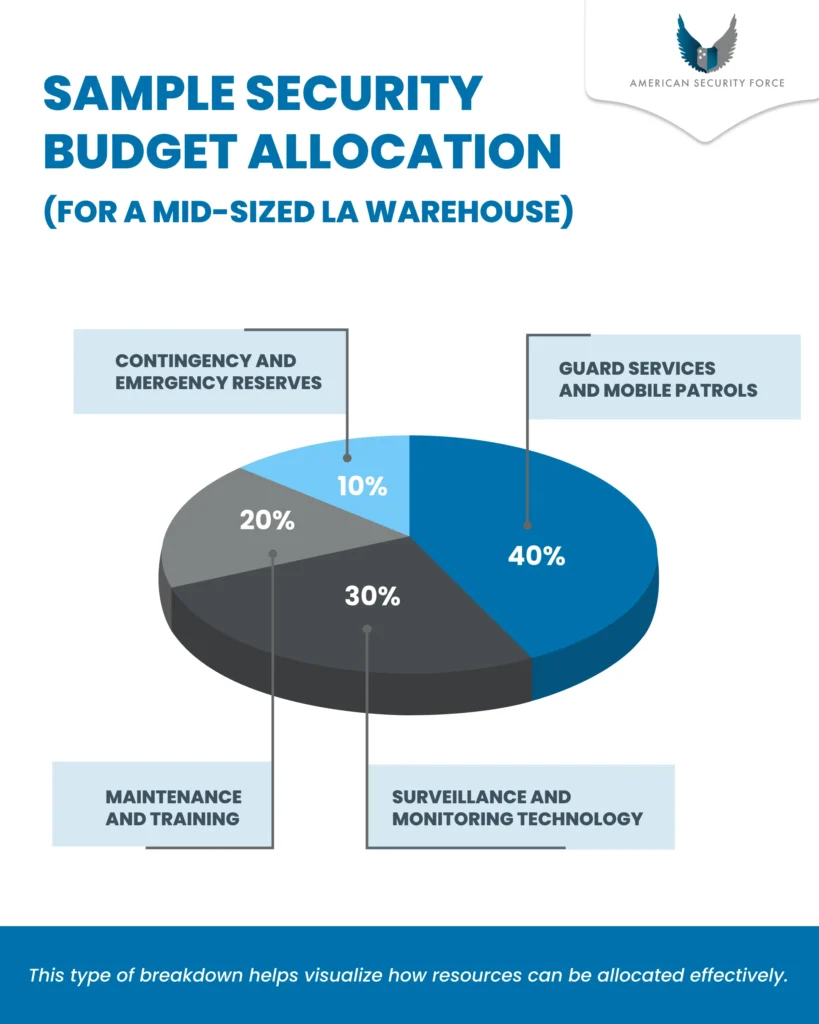
The following pie chart illustrates how a mid-sized Los Angeles warehouse might allocate its security budget. While every business has unique needs, this type of breakdown helps managers visualize how resources can be allocated effectively.
Building a Business Case
To get support for your security budget, you’ll need to show why the investment matters in clear business terms. This includes:
- Defining the core problem – Describe the main security issue in business terms. For example: “Theft incidents in our warehouse cost us $40,000 last year” or “We risk Cal/OSHA fines if access to restricted areas isn’t controlled.”
- Outlining the necessary actions – Explain what’s needed to fix the issue, such as guard patrols, access control systems, or staff training.
- Highlighting expected benefits – Show how the measures will reduce losses, improve safety, or protect compliance.
- Estimating costs – Provide a realistic view of upfront and ongoing expenses.
- Projecting ROI – Demonstrate the payoff, such as reduced theft, lower insurance premiums, or fewer disruptions to operations.
When presented this way, a security budget becomes less about “extra spending” and more about protecting revenue, reputation, and compliance. Decision-makers may also find it helpful to note that the physical security market is now worth over USD 143.5 billion globally. So clearly, many organizations are already prioritizing these investments.
Frequently Asked Questions About Security Budgeting
1. What percentage of revenue or operating budget should be allocated to physical security?
There’s no one-size-fits-all figure. In physical security, many businesses allocate 1%–3% of gross revenue (or 5%–15% of their “facilities & operations” budget), depending on risk profiles, facility size, and threat level. Use your risk assessment and local benchmarks as your guide.
2. How much does a security guard cost per hour in the LA area (or a large metro)?
In Los Angeles, a trained uniformed security guard typically costs between $25 and $40 per hour (depending on level, shift, and contract terms). Weekend, holiday, or overnight shifts often incur 10%–25% premium. (Note: local labor laws, union rules, or overtime rates can influence this.)
3. What’s a reasonable budget breakdown (percentages) across service categories?
Here’s a typical allocation you might see in a physical security budget:
- 35%–50% → Personnel (guards, patrols)
- 20%–35% → Technology & equipment (cameras, alarms, access control)
- 10%–20% → Maintenance, lifecycle & upgrades
- 5%–10% → Training, compliance, contingency funds
Use these proportions as a framework; shift them based on your specific risks.
4. How often should equipment (cameras, access systems) be replaced or upgraded?
Many security systems have a 5- to 7-year lifecycle. After about 5 years, components may become obsolete, lose vendor support, or fail to integrate with newer systems. Budget for periodic refresh cycles to avoid “tech debt.”
5. Can I scale down a security budget if my business is small or low risk?
Yes, but carefully. Even small sites should maintain a basic level of deterrence, such as one security patrol per night or a limited number of monitored cameras. Cutting to zero is risky. Use your risk assessment to scale gradually. Start with essential preventive measures before reactive ones.
6. What hidden or “surprise” costs do companies overlook in security budgeting?
Common unaccounted costs include:
- Overtime, holiday, or premium shift pay for guards
- Permitting, inspections, or local licensing fees (especially in LA)
- Network infrastructure for video systems (bandwidth, storage)
- False alarm costs or fines
- Insurance premium increases
- Staff training updates or recertification
7. How much should I set aside for unexpected security expenses?
It’s wise to allocate 5%–10% of your total security budget as a contingency fund. This covers unplanned costs such as emergency guard services, sudden equipment failures, or spikes in neighborhood crime that demand extra patrols.
Conclusion: Building a Scalable Security Budget
Security budgets require careful planning and foresight. By assessing upfront and ongoing costs, balancing preventive and reactive measures, and factoring in local considerations, you can create a budget that protects your people and assets without overspending.
At American Security Force, we help businesses in California and beyond plan flexible, scalable, and sustainable security budgets while simplifying the entire process.
Contact us today to see how we can help you plan and deploy unified threat deterrence, detection, and management systems to protect your business.