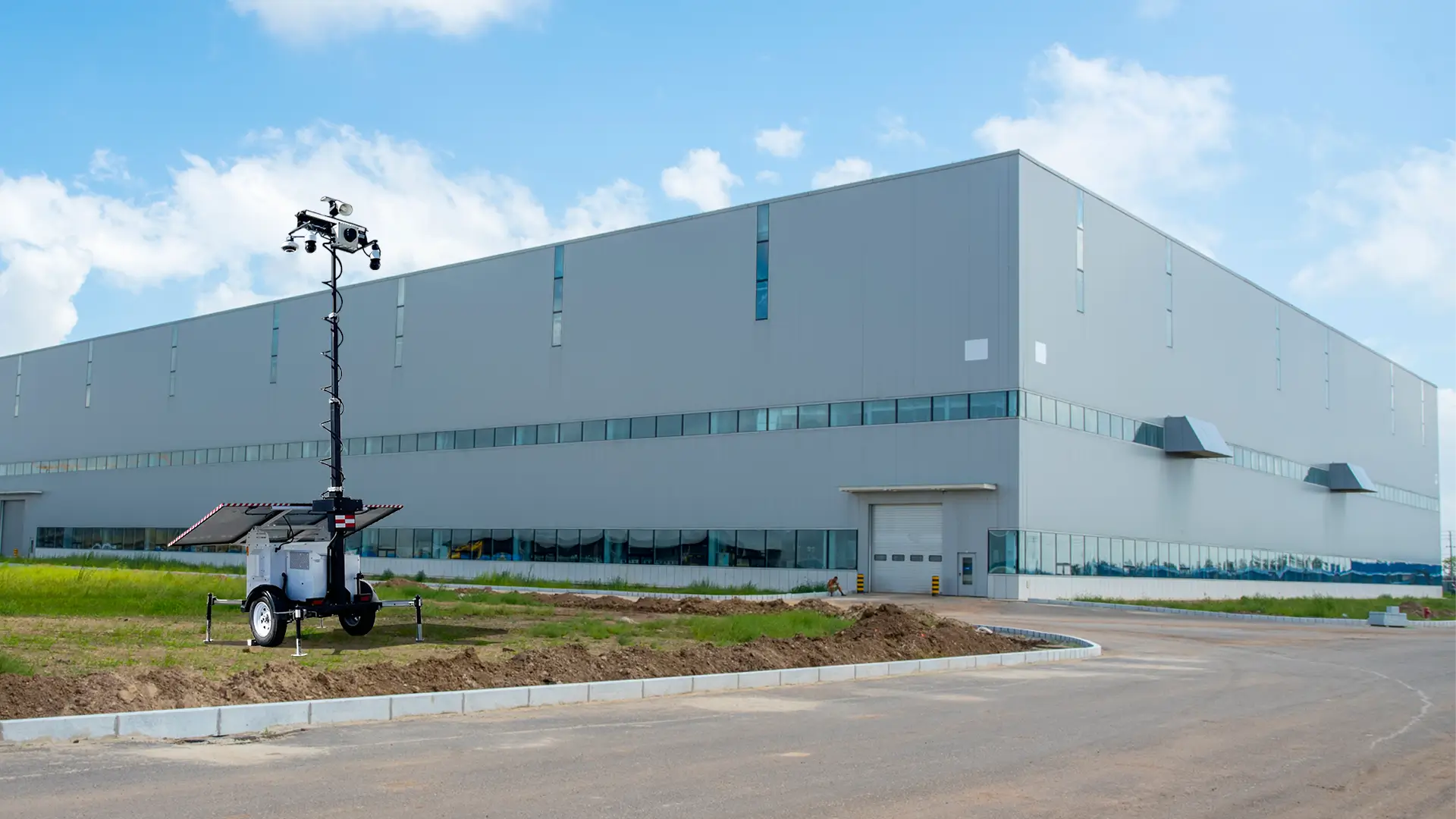




Between 2020 and 2024, U.S. fire departments responded to an average of 1,544 warehouse structure fires per year, or roughly four warehouse fires every day.
Fires are a major threat to warehouse security. They spread faster than most people realize, especially inside a large distribution facility with products, packaging, equipment, vehicles, and multiple access points.
That reality came into focus after the recent Kimberly-Clark warehouse fire in Ontario, California. According to the City of Ontario, firefighters responded to a commercial structure fire at a 1.2 million-square-foot distribution warehouse (roughly the size of 21 football fields under one roof). It escalated to a six-alarm response involving approximately 175 firefighters. The U.S. Department of Justice later reported that the fire destroyed the warehouse and caused approximately $500 million in damage.
For warehouse operators, distribution centers, property managers, and commercial facility owners, the scale of this incident raises an important question.
Not who is to blame or whether one company did enough. But what can large facilities learn from an incident of this size?
Key Takeaways
- A warehouse fire is not only a fire-safety issue. It can also expose gaps in visibility, communication, and response.
- Cameras are useful, but footage reviewed after an incident is not the same as real-time surveillance, monitoring, and escalation.
- Access control is a great tool for limiting where risk can spread from within.
- On-site guards add something technology cannot fully replace: human judgment, patrol presence, and immediate verification.
- The real lesson is not that every incident can be predicted. Layered warehouse security can help facilities detect problems earlier, respond faster, and reduce damage when every minute matters.
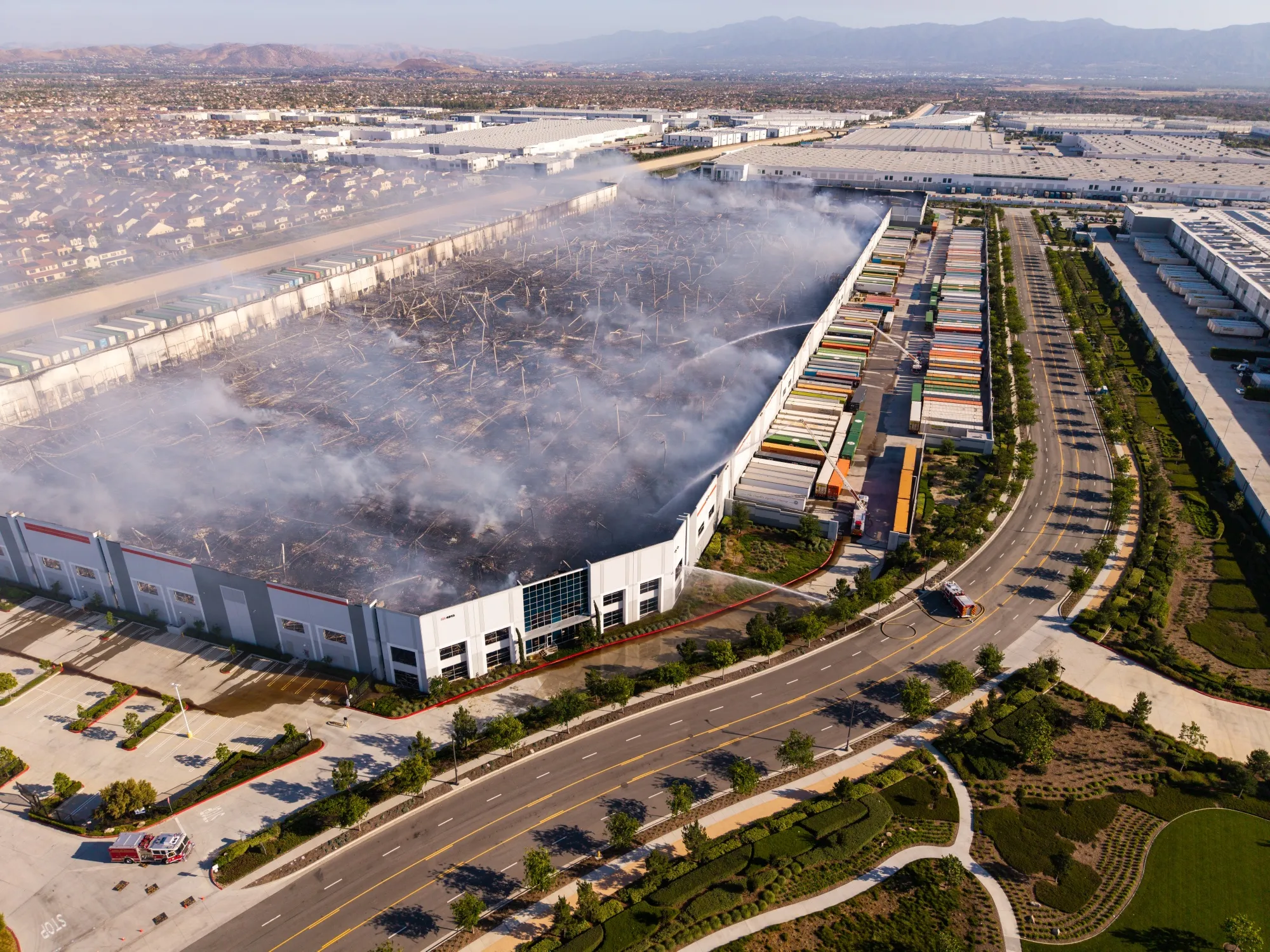
Source: Bloomberg
Important: This Is a Security Lessons Article, Not an Investigation
Before going further, it is important to clarify the focus of this article.
This is not an attempt to assign blame, speculate about the investigation, or claim that any specific security measure was missing. Public information about the incident remains limited, and each facility has its own procedures, risks, and response challenges.
Instead, this article looks at the broader warehouse security lesson: when a serious threat develops inside a facility, what layers of protection can help detect it earlier, slow its spread, improve response time, and reduce damage?
Surveillance Only Works When It Leads to Action
Surveillance cameras are one of the most common warehouse security tools. They are also one of the most misunderstood.
A camera by itself does not stop an incident. It records what happened. That footage can be valuable for investigations, insurance claims, and internal review, but footage reviewed after the fact does little to reduce damage while an incident is unfolding.
The real value of surveillance comes when cameras are connected to monitoring, alerts, verification, and response.
Warehouse surveillance cameras should do more than cover the front entrance. They should help security teams maintain visibility over areas such as:
- Main entrances and employee access points
- Loading docks and shipping doors
- Exterior yards and parking areas
- High-value inventory areas
- Restricted zones
- Equipment storage areas
- Fire lanes and emergency access points
- Perimeter fencing and gates
When surveillance is actively monitored, unusual activity can be detected sooner. A person entering a restricted area, movement near vulnerable materials, an open door after hours, smoke, suspicious behavior, or activity in an unexpected location can all trigger a faster response if someone is watching, verifying, and escalating.
Cameras Are Only One Part of Surveillance
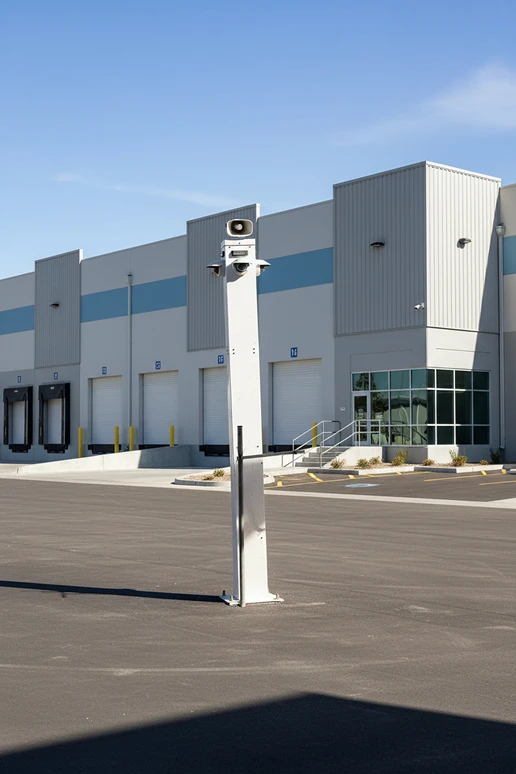
It is also important to remember that cameras are not the only form of surveillance. Large properties can also benefit from mobile surveillance that surpasses fixed camera systems’ capacity. Sentinel units, for example, provide portable, 360-degree site coverage, instant alerts, and visible deterrence.
This is where video monitoring solutions can support a stronger security program. When cameras are paired with analytics, visual verification, and response procedures, surveillance becomes more than documentation. It becomes part of an active security system.
However, the system still needs people and protocols behind it.
Security teams should know what to do when they see something unusual. Who do they call? When do they dispatch an on-site guard? How do they manage alerts? When do they contact emergency responders? What details need to be documented? Who confirms that the issue has been resolved?
Without clear escalation procedures, even the best surveillance system can become passive.
A monitoring and response center can help close that gap by supporting real-time visibility, communication, and coordination. For warehouses and distribution centers, this matters because many serious incidents are time-sensitive. The faster a concern is verified and escalated, the better chance a facility has to limit damage.
The lesson is simple: surveillance should not only answer the question, “What happened?” It should help answer, “What is happening right now, and who needs to act?”
Access Control Helps Limit Where Risk Can Spread
Access control is another critical layer in warehouse security.
Many facilities focus heavily on exterior threats: trespassing, theft, vandalism, break-ins, or unauthorized vehicles. Those risks matter, but large facilities also need to manage access inside the property.
Not every employee, vendor, contractor, or visitor needs access to every area. In a warehouse environment, access should be based on role, shift, location, time, and operational need.
That may include limiting access to:
- Inventory storage areas
- Shipping and receiving zones
- Control rooms
- Fire panels and utility areas
- Fleet and equipment areas
- Chemical or fuel storage
- Server rooms
- Administrative offices
- After-hours entry points
- High-value product zones
The goal is not to create a culture of mistrust. The goal is to reduce opportunity and limit exposure.
If something goes wrong, access control can help answer important questions. Who entered a certain area? When did they enter? Was the access authorized? Were there repeated access attempts? Did someone enter outside their normal schedule?
Those details can support faster internal review, better accountability, and clearer incident documentation.
Modern electronic access control systems can also integrate with other security tools (alarms and video surveillance). That integration matters because access events become more useful when they are connected to visual verification and response.
For example, if a restricted door is opened after hours, the system should not simply log the event. It should help the security team verify what happened, determine whether the access was legitimate, and respond based on the level of risk.
On-Site Security Guards Add Judgment, Patrol, and Immediate Presence
Technology is essential, but it cannot replace human judgment.
On-site security personnel play a different role from cameras, alarms, and access systems. Guards can observe behavior, patrol large areas, verify alerts, assist with evacuations, communicate with employees, and coordinate with emergency responders.
In a warehouse environment, trained security guards may notice things that technology alone may not fully interpret:
- Smoke, odors, or unusual heat
- Blocked exits or fire lanes
- Doors left open
- Suspicious movement
- Unauthorized access attempts
- Unusual vehicle activity
- Employees or visitors in restricted areas
- Equipment or materials are placed where they should not be
- Safety hazards that need escalation
On-site guards can also support faster response. If a camera alert comes in, a guard may be able to physically verify the situation. If an alarm activates, a guard can check the area and provide accurate information to supervisors or emergency responders.
The strongest security programs do not treat guards and technology as separate systems. They connect them.
Fire and Intrusion Monitoring Help Turn Alerts Into Action
Security and fire safety are not the same discipline, but in large facilities, they often overlap.
Guard teams may be among the first to notice smoke, alarm activity, unusual movement, unauthorized access, or signs that something is wrong. That makes fire-safety awareness an important part of broader facility security planning.
This does not mean security replaces fire prevention systems, sprinklers, code compliance, fire inspections, or the fire department. Those are separate and essential parts of facility safety.
Security can support faster detection, verification, and communication.
A fire alarm, intrusion alarm, or unusual camera alert should not sit in isolation. The faster the right people understand what is happening, the faster the response can begin.
That is where fire and intrusion monitoring solutions can support a layered security approach. When monitoring is connected with video surveillance, access control, and response procedures, teams may be able to verify threats more quickly and communicate clearer information to management or emergency responders.
For example, if an alarm is triggered in a warehouse, security teams should be able to determine:
- Where did the alert originate?
- Is there visual confirmation?
- Is anyone in the area?
- Are there access logs connected to the event?
- Does an on-site guard need to verify it?
- Does management need to be notified?
- Should emergency services be contacted immediately?
- Are evacuation or access-control procedures needed?
Fire and intrusion monitoring should be viewed as part of an overall response chain. It helps turn alerts into decisions and decisions into action.
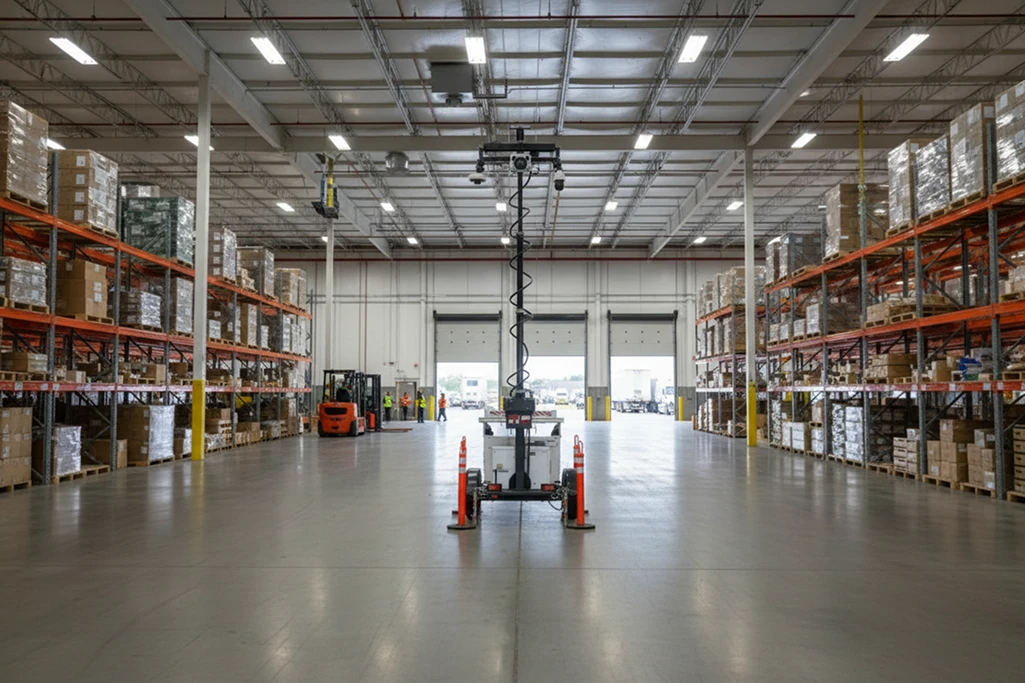
Security Escalation Procedures Can Make or Break the Response
Even strong security tools can fall short if the people using them do not know how to escalate concerns.
A warehouse security plan may include cameras, alarms, guards, access controls, and monitoring systems, but the response still depends on the process in place.
A strong escalation plan should define:
- What types of activity require immediate reporting
- Who receives security reports
- Who has the authority to escalate to emergency services
- How guards communicate with supervisors
- How monitoring teams communicate with on-site personnel
- How incidents are documented
- How employees are notified during emergencies
- How evacuation routes and access points are managed
- How post-incident reporting is handled
Those questions should be answered before an incident occurs. The best plans are simple enough to follow under pressure.
The Real Lesson: Warehouse Security Needs Multiple Layers
Large-facility incidents are difficult to predict, but easier to manage with layers. No security plan can predict every threat before it begins.
Warehouses, especially large ones, are complex environments. They often operate across multiple shifts, with employees, contractors, vendors, drivers, visitors, and delivery traffic moving through the property at different times. They may include loading docks, storage racks, high-value inventory, fuel areas, packaging materials, fleet zones, restricted rooms, and large exterior yards.
That complexity creates security challenges.
A facility may have cameras in place, but without active monitoring, important warning signs can still go unnoticed. Access control may exist, but sensitive areas can remain exposed if permissions are too broad. Guards may be present, but limited visibility across a large site can slow verification. Fire and intrusion alarms can help trigger awareness, but without a clear process for confirming the threat and escalating the response, valuable time may still be lost.
That is why warehouse security should not rely on one tool, one person, or one procedure.
The better approach is layered security: a combination of surveillance, monitoring, access control, on-site security personnel, fire and intrusion detection, patrols, reporting, and emergency escalation procedures. Each layer has a different role. Together, they improve visibility, reduce blind spots, and help teams act faster when every minute matters.
For large facilities, a strong warehouse security strategy is not only about preventing unauthorized entry. It is also about identifying both internal and external risks, communicating clearly, and reducing the impact of serious incidents.
A camera alone or a guard is not enough. Access control alone is not enough. A fire alarm alone is not enough.
The strength comes from the way those layers work together.
Build a Stronger Warehouse Security Plan
American Security Force helps warehouses, distribution centers, and commercial properties build layered security programs that combine trained personnel, surveillance monitoring, access control, patrols, and fire and intrusion monitoring. If your facility needs a stronger plan for identifying risks earlier and responding faster, contact us to discuss the right security approach for your site.